
 en
en  English
 中文简体
中文简体 عربى
عربى
Demand charges — fees utilities levy based on a facility's peak power draw — have quietly become one of the largest line items on commercial and industrial electricity bills. For many factories, warehouses, and commercial buildings, these charges account for 30% to 70% of total electricity costs, yet they reflect only a few minutes of high consumption each month. A commercial and industrial energy storage system (C&I ESS) addresses this directly, and the economics have never been more favorable.
Content
- 1 Why Businesses Are Investing in C&I Energy Storage Now
- 2 How a Commercial and Industrial Energy Storage System Works
- 3 Key Applications and Use Cases
- 4 Battery Technologies Used in C&I ESS
- 5 How to Size and Select a C&I Energy Storage System
- 6 Industry-Specific Applications
- 7 Return on Investment and Payback Period
Why Businesses Are Investing in C&I Energy Storage Now
Two converging trends are accelerating C&I energy storage adoption. First, electricity costs are rising faster than general inflation in most markets, and time-of-use tariffs are being extended to more commercial and industrial customer classes. Second, battery costs have collapsed. According to IRENA, fully installed battery storage project costs dropped 93% between 2010 and 2024 — from roughly USD 2,571/kWh to USD 192/kWh — making storage a standard capital investment rather than a niche technology. By 2024, global battery manufacturing capacity reached 3 TWh, ensuring supply availability across project sizes.
The market reflects this shift. The global C&I energy storage market reached approximately USD 91.99 billion in 2025 and is projected to grow to USD 164.23 billion by 2030, driven by peak shaving, backup power mandates, and corporate decarbonization targets. Peak shaving alone accounted for over 21% of revenue share in the sector in 2024 — the single largest application — and that share continues to grow as demand charge structures become more aggressive.
For facilities that have already analyzed their load profiles, the math on storage investment has moved from "interesting" to "compelling." For those that haven't, the first step is understanding what a commercial-grade containerized battery energy storage system actually does inside a facility — and how it earns its return.
How a Commercial and Industrial Energy Storage System Works
A C&I ESS is not simply a large battery. It is an integrated system comprising four functional layers that work together to store, manage, and deploy electricity precisely when and where it delivers the most value.
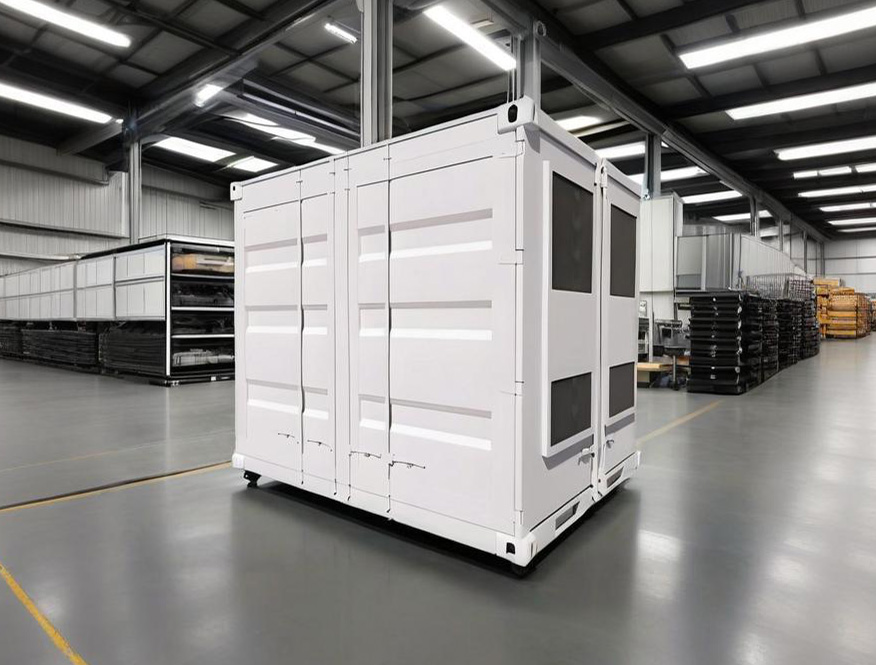
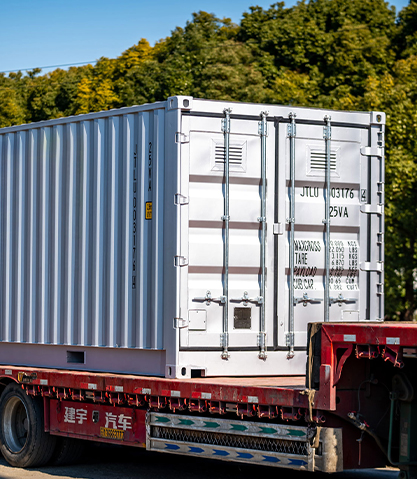
The battery module stores energy electrochemically, typically using lithium iron phosphate (LiFePO4) chemistry for its combination of long cycle life, thermal stability, and safety under high-load conditions. A 100 kWh system might occupy a single cabinet; a 1 MWh system is typically housed in a standardized container for easier deployment and future scalability.
The Battery Management System (BMS) monitors every cell's voltage, temperature, and state of charge in real time. It prevents overcharging, over-discharging, and thermal runaway — protecting the asset and ensuring consistent performance over thousands of cycles.
The Power Conversion System (PCS) handles the translation between DC power stored in the battery and AC power used by the facility or fed to the grid. Its response time — typically measured in milliseconds — determines how quickly the system can respond to sudden load spikes.
The Energy Management System (EMS) is the intelligence layer. It reads utility tariff schedules, facility load forecasts, and real-time grid signals, then optimizes charge and discharge decisions automatically. In grid-connected mode, the EMS ensures the facility draws less peak power from the grid; in backup mode, it seamlessly switches to island operation when grid power fails.
Key Applications and Use Cases
C&I energy storage systems serve multiple functions simultaneously, and most facilities capture value from more than one application within the same hardware investment.
Peak shaving and valley filling is the primary driver for most C&I deployments. The system charges during low-tariff night hours and discharges during high-tariff peak periods, directly reducing demand charges and energy arbitrage costs. A well-configured system can reduce monthly peak demand by 15–25%, which translates to immediate bill reduction.
Backup power for critical operations addresses the business continuity risk of grid outages. For factories with continuous production lines, hospitals, and data centers, even brief outages trigger significant financial losses. A C&I ESS with seamless transfer switching provides uninterrupted power supply without the fuel cost, noise, and emissions of diesel backup generators.
AC grid expansion deferral allows facilities to avoid or defer expensive transformer upgrades and grid connection capacity increases. When a facility's peak demand approaches its contracted grid capacity limit, storage can absorb that peak, delaying infrastructure investment by years.
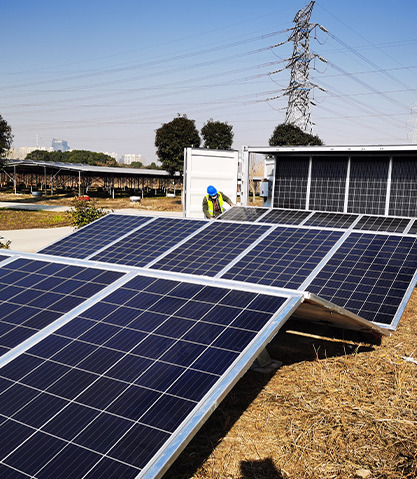
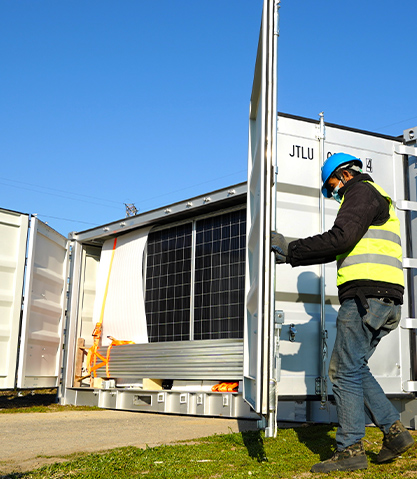
Renewable energy integration maximizes the value of on-site solar generation by storing excess midday production for use during evening peaks or overnight operations. Paired with solar power container solutions for on-site generation, storage converts a solar investment from a daytime-only asset into a 24-hour energy management tool.
Off-grid and emergency power supply serves facilities in locations where grid reliability is low, grid connection costs are prohibitive, or where regulatory backup power requirements must be met. Self-provided power supply solutions using battery storage enable full energy independence for remote industrial sites, field operations, and critical infrastructure.
Battery Technologies Used in C&I ESS
Lithium iron phosphate (LiFePO4) dominates C&I energy storage, capturing over 80% of the market in 2024. Its chemistry delivers thermal stability up to 270°C before decomposition — compared to approximately 150–200°C for NMC lithium chemistries — which is why it is the preferred choice for enclosed installations, industrial environments, and applications where safety certification is mandatory.
The cycle life of LiFePO4 is another decisive factor. Quality commercial cells deliver 4,000–6,000 full charge-discharge cycles with less than 20% capacity degradation, translating to 10–15 years of operational life under daily cycling. This longevity is critical for ROI calculations in peak shaving applications where the system cycles every day.
For outdoor and harsh-environment deployments, protection rating matters as much as chemistry. An IP67-rated enclosure — fully dust-tight and capable of withstanding immersion in water up to one meter — ensures reliable operation in manufacturing yards, rooftop installations, coastal facilities, and locations subject to flooding or high humidity. This protection level is the baseline standard for serious industrial deployments and significantly reduces maintenance requirements over the system's life.
Emerging alternatives include sodium-ion batteries, which are gaining traction for stationary storage due to their use of abundant materials, and vanadium flow batteries for long-duration applications exceeding 8 hours. However, for the 1–4 hour discharge durations that cover most C&I peak shaving and backup power needs, LiFePO4 remains the most mature and cost-effective solution.
How to Size and Select a C&I Energy Storage System
Correct sizing is where many C&I storage projects succeed or fail. Oversizing wastes capital; undersizing leaves significant savings on the table and may not meet backup power duration requirements.
The process starts with load data. A minimum of 12 months of 15-minute interval electricity consumption data reveals the facility's peak demand patterns, the frequency and duration of high-demand events, and the spread between peak and off-peak consumption. This data determines both the power rating (kW) and the energy capacity (kWh) the system needs to deliver.
For peak shaving, the key metric is the demand threshold the system needs to hold below. If a facility's peak demand averages 800 kW but spikes to 1,100 kW during shift changes, a system rated at 300 kW power output with 300–600 kWh of storage capacity (covering 1–2 hours) addresses that specific problem. For backup power, the calculation shifts to critical load identification — what must stay on, for how long — and the system is sized to match that duration at that load level.
Modular designs offer meaningful flexibility. Containerized systems that follow standard shipping dimensions can be expanded by adding parallel units as facility energy needs grow, without replacing the entire installation. This scalability is particularly valuable for manufacturing facilities undergoing expansion or for sites phasing in additional renewable capacity.
Certification requirements vary by market. Key standards to verify include UL 9540 and UL 9540A for fire safety and thermal runaway propagation testing, IEC 62619 for safety requirements in stationary applications, and local grid connection standards. Systems deployed in incentive-eligible markets — such as those qualifying for the U.S. Inflation Reduction Act's standalone storage Investment Tax Credit — must meet additional domestic content and technical standards.
Industry-Specific Applications
While the core technology is the same, the value proposition of C&I energy storage differs substantially by industry based on tariff structure, load profile, and operational criticality.
In manufacturing and industrial parks, heavy equipment cycling — motors starting under load, compressors ramping, furnaces drawing surge current — creates sharp, frequent demand spikes that drive high demand charges. Storage flattens these spikes and enables demand charge management without constraining production scheduling. Industrial infrastructure energy storage applications cover everything from stamping plants to food processing facilities.
In data centers, the value is primarily resilience. Uninterruptible power supply requirements are absolute, and the economics of avoiding even a single unplanned outage can justify a storage system's full cost. Storage also reduces peak demand from high-density server racks and cooling systems, which carry substantial demand charges in most utility territories.
In commercial buildings — office complexes, shopping centers, hotels — HVAC systems are the dominant load driver. Peak cooling demand on summer afternoons aligns precisely with peak pricing windows, making storage a natural fit. Buildings in markets with both time-of-use and demand charges typically achieve the fastest payback periods.
In port and maritime applications, cold ironing — supplying shore power to berthed vessels — creates highly variable, high-peak loads that challenge grid connection capacity. Port and shore power energy storage solutions enable ports to meet emissions regulations without expanding permanent grid infrastructure at every berth.
Return on Investment and Payback Period
The financial case for C&I energy storage is built on multiple revenue and cost-reduction streams, and most projects stack at least two of them. Peak shaving and demand charge reduction typically form the base case; backup power avoided cost and incentive credits layer on top.
Demand charges in markets like California, Germany, and Japan can run USD 10–30 per kW per month. A system that reduces peak demand by 200 kW in a USD 15/kW market generates USD 3,000 in monthly savings — USD 36,000 annually — from demand charge reduction alone. Add time-of-use arbitrage from buying cheap overnight power and displacing peak-rate grid consumption, and the annual savings figure grows further.
Across typical C&I deployments, total electricity cost reductions of 10–40% are achievable, with the highest savings at sites with highly variable loads, aggressive demand charge structures, and high peak-to-off-peak tariff spreads. Simple payback periods in well-designed projects currently range from 4 to 7 years, and declining battery costs continue to compress this timeline.
Policy incentives accelerate the math significantly in eligible markets. The U.S. Inflation Reduction Act's standalone storage ITC reduces the levelized cost of storage to approximately USD 124/MWh for qualifying systems. Similar mechanisms exist in the EU, UK, Japan, and Australia, creating additional incentive to move investment decisions forward.
For businesses evaluating a storage investment, the starting point is a site energy audit combined with a tariff analysis. Exploring the full range of C&I energy storage solutions by application and scale helps match the right system configuration to the facility's specific load profile and financial objectives.