

 en
en  English
 中文简体
中文简体 عربى
عربى
Content
- 1 What Makes a Battery ESS Container the Right Choice for C&I Facilities
- 2 Peak Shaving and Valley Filling: Cutting Demand Charges at the Source
- 3 AC Power Grid Expansion Without the Infrastructure Cost
- 4 Factory Backup Power: Protecting Production from Outages
- 5
- 6 Industrial Power Guarantee Solution for Mission-Critical Operations
- 7 Off-Grid Emergency Power Supply System: Energy Independence Where the Grid Cannot Reach
- 8 Selecting the Right System: Key Parameters to Align with Your Application
What Makes a Battery ESS Container the Right Choice for C&I Facilities
For commercial and industrial facilities dealing with rising energy costs, unreliable grid supply, and growing pressure to maintain uptime, a Battery ESS Container offers a purpose-built answer. Unlike rack-mounted or indoor-only storage units, containerized energy storage systems are engineered for deployment in demanding real-world environments — factories, logistics hubs, construction sites, and remote industrial zones.
One of the most distinguishing features of a well-designed industrial ESS container is its IP67 protection rating. This means the enclosure is fully dust-tight and can withstand temporary immersion in water up to 1 meter for 30 minutes. In practice, this translates to reliable performance in outdoor environments exposed to rain, humidity, dust from manufacturing processes, and temperature fluctuations — conditions that would compromise standard equipment.
Beyond protection, the containerized format supports scalability. Systems can be deployed as standalone units or clustered to reach megawatt-hour capacity, making them appropriate for everything from a mid-sized factory requiring 200 kWh of backup energy to a large industrial campus needing multi-MWh energy management. The self-contained design also reduces installation time significantly — often from weeks to days — since the system arrives pre-assembled and pre-tested.
Peak Shaving and Valley Filling: Cutting Demand Charges at the Source
Demand charges — fees based on the highest 15-minute power draw within a billing cycle — can account for 30% to 50% of a commercial electricity bill. Peak shaving directly targets this cost by discharging stored energy during high-demand windows, reducing the facility's draw from the grid precisely when rates are most punishing.
Valley filling complements this by charging the Battery ESS Container during off-peak hours, typically late at night when time-of-use (TOU) rates are lowest. Together, these two strategies form an energy arbitrage cycle that consistently lowers operating costs without disrupting production schedules or operational workflows.
Consider a manufacturing plant running heavy stamping equipment with a consistent peak demand of 800 kW between 2 PM and 6 PM. A properly sized BESS can discharge during this window, reducing the visible grid peak to 500 kW. Over a 12-month period, this kind of demand reduction can translate to annual savings of $40,000–$120,000 depending on local utility tariffs and facility size.
Key metrics to evaluate before deployment:
- Peak demand duration: How long do your peaks typically last? Systems should be sized to sustain discharge across the full peak window.
- TOU rate differential: A larger spread between peak and off-peak rates increases the financial case for valley filling.
- Cycle life: Industrial applications require cells rated for 4,000+ charge cycles to deliver an acceptable payback period.
- Round-trip efficiency: Look for systems above 90% efficiency to minimize energy loss in the charge-discharge cycle.
AC Power Grid Expansion Without the Infrastructure Cost
Many industrial facilities reach a point where expanding production capacity runs directly into grid connection limits. Upgrading a transformer, laying new cables, or negotiating a higher grid connection capacity with the utility can cost anywhere from $200,000 to several million dollars — and take 12 to 36 months to complete.
A Battery ESS Container deployed as an AC grid buffer provides a faster, more cost-effective path. By absorbing excess generation or supplementing supply during demand surges, the system effectively expands the usable power envelope of an existing grid connection. This is particularly valuable for facilities adding EV charging infrastructure, new production lines, or high-power processing equipment without the budget or timeline for full grid upgrades.
The system integrates at the AC side of the facility's main distribution panel, working in parallel with the grid. An integrated energy management system (EMS) monitors real-time load and automatically coordinates when to charge, hold, or discharge — keeping the facility within its contracted grid capacity at all times.
Factory Backup Power: Protecting Production from Outages
Unplanned power outages cost manufacturers an average of $260,000 per hour according to industry research. For facilities running continuous processes — chemical production, semiconductor fabrication, food processing, or cold chain logistics — even a 10-minute outage can result in scrapped batches, equipment damage, or safety incidents.
A containerized BESS configured for factory backup power switches to island mode within milliseconds of detecting a grid fault, providing seamless continuity to critical loads. Unlike diesel generators, which take 10–30 seconds to reach full output and require ongoing fuel management, a battery-based backup responds instantaneously and operates silently with zero local emissions.
Backup duration is configurable based on the facility's critical load profile. A 500 kWh Battery ESS Container supporting a 100 kW critical load delivers 5 hours of autonomy — sufficient to ride through most utility outages or safely execute a controlled shutdown of sensitive equipment.
| Backup Technology | Response Time | Emissions | Maintenance |
|---|---|---|---|
| Battery ESS Container | < 20ms | Zero (local) | Low |
| Diesel Generator | 10–30 seconds | High | High |
| UPS (lead-acid) | < 20ms | Zero (local) | Medium |
Industrial Power Guarantee Solution for Mission-Critical Operations
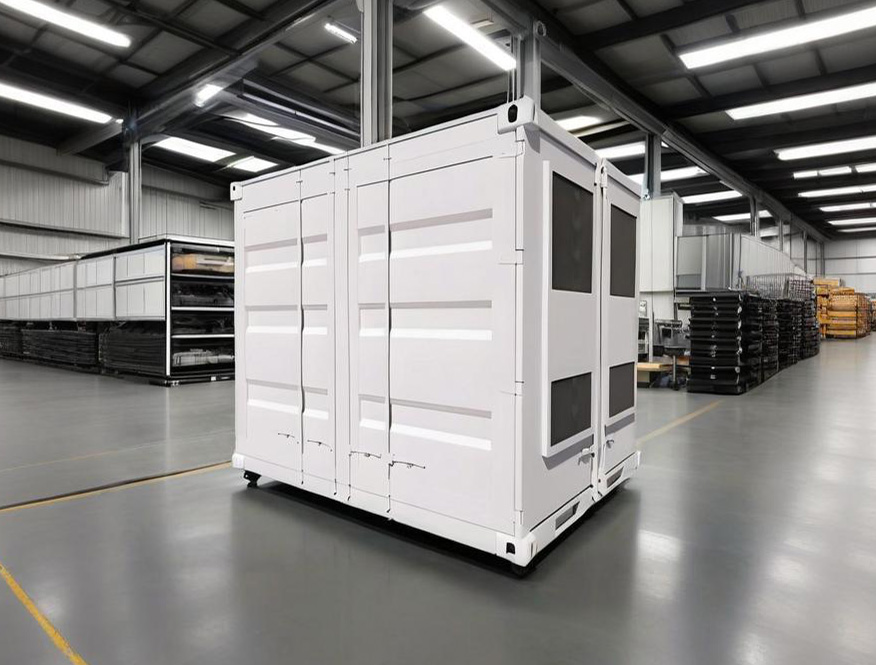
An industrial power guarantee solution goes beyond simple backup. It ensures that a facility's power supply meets defined quality and reliability standards at all times — including voltage stability, frequency regulation, and uninterrupted availability. This is the standard expected in industries like pharmaceuticals, data hosting, automotive assembly, and precision engineering, where power anomalies directly affect product quality and compliance.
A Battery ESS Container deployed as part of a power guarantee architecture works continuously — not just during outages. It actively conditions the incoming AC supply, absorbs micro-interruptions and voltage sags, and maintains a clean, stable output to sensitive equipment. When combined with on-site solar or other distributed generation, it also enables facilities to maximize self-consumption and reduce dependence on the external grid entirely.
For facilities operating under strict power quality requirements, the IP67 rating of the enclosure ensures that the system itself remains fully operational regardless of ambient conditions — whether deployed in a tropical climate with high humidity or an industrial zone with heavy particulate contamination.
Off-Grid Emergency Power Supply System: Energy Independence Where the Grid Cannot Reach
Some operations simply cannot wait for grid infrastructure — remote mining sites, island facilities, disaster-response staging areas, temporary construction camps, and military forward bases all require a reliable off-grid emergency power supply system that can be deployed rapidly and operate autonomously for extended periods.
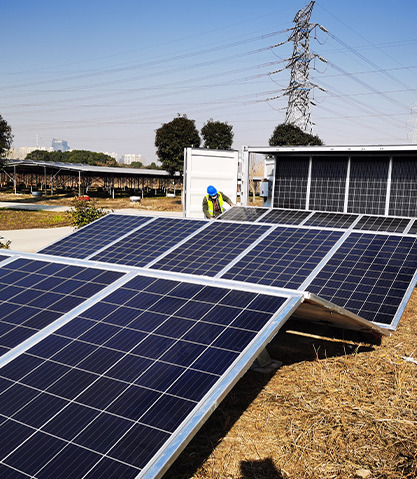
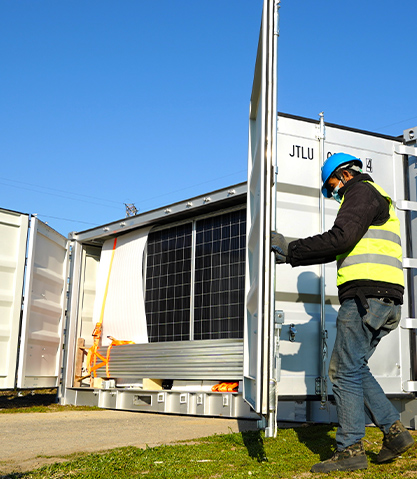
A Battery ESS Container in off-grid configuration typically pairs with diesel generators or renewable sources such as solar PV arrays. The battery handles moment-to-moment load fluctuations and stores excess generation, while the generator or solar input recharges the system over time. This hybrid approach dramatically reduces generator run hours — often by 60% to 80% — cutting fuel consumption, maintenance intervals, and total operating cost.
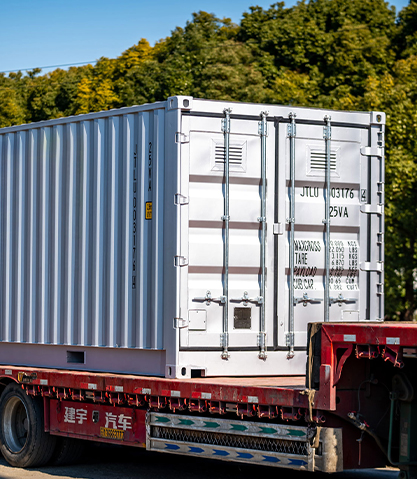
In emergency response scenarios, the containerized format is a strategic advantage. Units can be transported by standard flatbed truck or cargo ship, positioned on uneven or unprepared ground, and commissioned within hours. The IP67-rated enclosure ensures the system remains fully functional even if deployed in flood-prone areas or exposed to heavy rain during field operations.
Common off-grid deployment scenarios:
- Remote mining and drilling sites where grid connection costs exceed project timelines
- Island or coastal industrial facilities with unreliable submarine cable supply
- Disaster recovery and humanitarian relief operations requiring rapid power deployment
- Temporary construction or event sites with high power demand and no fixed infrastructure
- Agricultural processing facilities in rural regions with weak or absent grid coverage
Selecting the Right System: Key Parameters to Align with Your Application
Not every Battery ESS Container is suited for every use case. Before specifying a system, facilities and procurement teams should evaluate the following parameters against their operational requirements:
- Usable capacity (kWh): Determine the energy volume needed to cover peak shaving windows, backup duration, or off-grid autonomy periods. Always account for depth of discharge limits — a system rated at 500 kWh may deliver 450 kWh usable at 90% DoD.
- Power output (kW): The continuous discharge rate must match your critical or peak load profile. Undersizing the power rating — even if the energy capacity is sufficient — will result in voltage drop under heavy load.
- Thermal management: Active liquid cooling or forced-air systems maintain cell temperature within optimal ranges, directly affecting cycle life and safety in high-ambient environments.
- Communication protocols: Ensure compatibility with your existing SCADA, EMS, or building management systems. Modbus, CAN bus, and IEC 61850 are standard in industrial applications.
- Certifications: For international deployment, verify compliance with IEC 62619, UN 38.3, and regional grid codes applicable to your target market.
With the right system specification and deployment strategy, a Battery ESS Container delivers measurable returns across every application — from reducing monthly demand charges in a grid-connected factory to providing fully autonomous power in remote field operations. The IP67-rated, modular architecture makes it one of the most versatile and resilient energy storage platforms available for demanding commercial and industrial environments today.
