

 en
en  English
 中文简体
中文简体 عربى
عربى
Content
- 1 Understanding Mobile Solar Power Container Systems
- 2 Core Components and System Architecture
- 3 Design Configurations and Capacity Options
- 4 Deployment Process and Site Preparation
- 5 Practical Applications and Use Cases
- 6 Economic Analysis and Financial Considerations
- 7 Maintenance Requirements and Service Procedures
- 8 Safety Standards and Regulatory Compliance
- 9 Future Developments and Technology Trends
Understanding Mobile Solar Power Container Systems
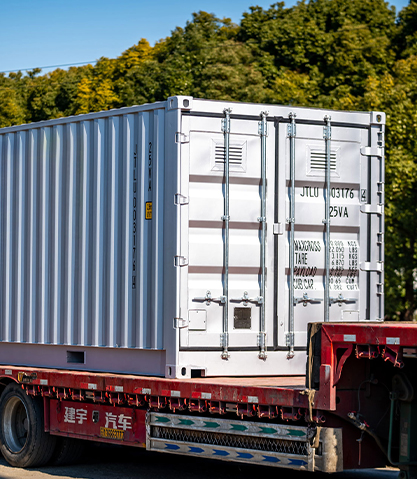
Mobile solar power containers represent a revolutionary approach to portable renewable energy generation, combining photovoltaic technology with standardized shipping container infrastructure. These self-contained power generation units integrate solar panels, battery storage systems, inverters, and control electronics within weatherproof ISO shipping containers, creating deployable energy solutions for remote locations, emergency response, construction sites, military operations, and off-grid applications. The containerized design enables rapid deployment using standard freight transportation methods including trucks, trains, ships, and cargo aircraft, while protecting sensitive electronic components from environmental exposure during transit and operation.
The typical mobile solar power container utilizes either 20-foot or 40-foot ISO container dimensions, providing 160 to 320 square feet of interior space for equipment installation. Rooftop-mounted solar arrays generate between 10 kW and 100 kW of peak power depending on container size and panel efficiency, while integrated battery banks store 50 kWh to 500 kWh of energy for nighttime operation and load balancing. Advanced systems incorporate diesel or natural gas generators for hybrid operation, ensuring continuous power availability during extended periods of cloud cover or peak demand events exceeding solar generation capacity. The modular architecture allows multiple containers to interconnect, creating scalable power plants ranging from small microgrids serving individual facilities to utility-scale installations providing megawatts of generating capacity.
Core Components and System Architecture
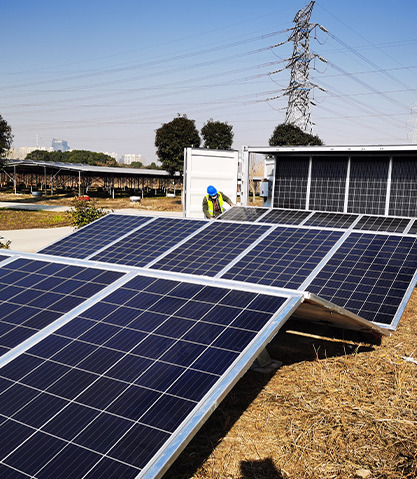
Mobile solar power containers integrate multiple subsystems working together to capture, convert, store, and distribute electrical energy. The photovoltaic array forms the primary generation source, with monocrystalline or polycrystalline solar panels mounted on reinforced rooftop racks or deployable ground arrays that extend the effective collection area beyond the container footprint. Panel configurations typically employ series-parallel arrangements generating 600-1000 VDC bus voltages, optimizing power transfer efficiency while minimizing conductor losses. Maximum power point tracking controllers continuously adjust operating voltage to extract optimal energy from panels under varying irradiance and temperature conditions, improving daily energy harvest by 15-25% compared to fixed voltage systems.
Battery energy storage systems utilize lithium-ion, lithium iron phosphate, or advanced lead-acid technologies selected based on performance requirements, budget constraints, and environmental operating conditions. Lithium iron phosphate batteries dominate modern installations due to superior cycle life exceeding 5,000 deep discharge cycles, excellent thermal stability reducing fire risk, and flat discharge curves maintaining stable voltage throughout the discharge cycle. Battery management systems monitor individual cell voltages, temperatures, and state of charge, implementing protective measures including charge current limiting, low voltage disconnect, and thermal management to prevent damage and maximize service life. The battery bank size is calculated based on required autonomy periods, typically ranging from 4 hours for grid-connected applications to 72 hours for critical off-grid installations requiring multi-day energy security.
Power Conversion and Distribution Equipment
- Bidirectional inverters - Convert DC power from solar panels and batteries to grid-quality AC power at 120/240V single-phase or 208/480V three-phase outputs, with pure sine wave output and total harmonic distortion below 3% ensuring compatibility with sensitive electronic loads and motor-driven equipment.
- Automatic transfer switches - Seamlessly transition between solar power, battery power, generator backup, and grid connection when available, with transfer times under 100 milliseconds preventing disruption to critical loads and maintaining uninterrupted power supply functionality.
- Load management controllers - Implement priority-based power allocation during limited generation conditions, automatically shedding non-essential loads while maintaining power to critical systems, with programmable scheduling enabling demand response and time-of-use optimization.
- Distribution panels and circuit protection - Housed within the container providing organized power distribution through circuit breakers, ground fault protection, arc fault detection, and surge suppression, with capacity ranging from 100A to 800A main service depending on system size.
- Monitoring and control systems - Touchscreen interfaces and remote SCADA connectivity enable real-time monitoring of generation, consumption, battery state, and system health parameters, with data logging capabilities supporting performance analysis and predictive maintenance scheduling.
Thermal management systems maintain optimal operating temperatures for electronics and batteries, critical for performance and longevity in extreme climate conditions. HVAC systems incorporating both heating and cooling capacity maintain interior temperatures between 15°C and 30°C, with insulated container walls reducing thermal load and improving efficiency. Battery thermal management may include liquid cooling loops or forced air circulation with temperature sensors triggering active cooling when cell temperatures exceed 35°C. In cold climate applications, resistance heaters or heat pumps prevent battery temperatures from dropping below -10°C, maintaining adequate discharge capacity and preventing lithium plating damage during charging operations.
Design Configurations and Capacity Options
Mobile solar power containers are manufactured in multiple standard configurations addressing different power requirements and deployment scenarios. The selection criteria include required continuous power output, peak surge capacity, daily energy consumption, autonomy requirements, and whether the system operates as primary power source, grid-interactive supplement, or emergency backup. Container specifications define not only electrical capacity but also physical characteristics including weight distribution, lifting points, fork pockets, and twist-lock positions ensuring compatibility with standard intermodal handling equipment.
| Container Size | Solar Capacity | Battery Storage | Continuous Output | Typical Applications |
| 10ft Container | 5-10 kW | 20-40 kWh | 5 kW | Small remote sites, telecom towers |
| 20ft Container | 15-30 kW | 50-150 kWh | 15-25 kW | Construction sites, events, emergency response |
| 40ft Container | 40-80 kW | 200-400 kWh | 40-60 kW | Mining operations, military bases, microgrids |
| 40ft High Cube | 60-100 kW | 300-500 kWh | 60-80 kW | Large facilities, industrial applications |
| Multi-Container Array | 100+ kW | 500+ kWh | 100+ kW | Village electrification, utility projects |
Specialized configurations address unique deployment requirements through modified designs. Expandable containers incorporate hydraulically-deployed solar panel wings that extend outward from the container sides, tripling or quadrupling the effective solar collection area while maintaining compact transport dimensions. Trailer-mounted units integrate the container onto road-transportable chassis with integrated leveling jacks, electrical connections, and stabilization systems enabling rapid deployment without requiring separate handling equipment. Extreme environment variants feature enhanced insulation, Arctic-rated components, and corrosion-resistant coatings for operation in temperatures ranging from -40°C to +50°C or in marine environments with salt spray exposure.
Deployment Process and Site Preparation
Successful mobile solar power container deployment requires systematic site assessment, preparation, installation, and commissioning procedures ensuring safe and efficient operation. The deployment timeline typically ranges from 2 days for simple installations to 2 weeks for complex multi-container systems requiring extensive ground array installation and grid interconnection. Site selection considers solar resource availability, ground conditions supporting container weight, accessibility for delivery vehicles, clearance from overhead obstructions, and proximity to electrical loads minimizing distribution cable requirements and voltage drop losses.
Foundation requirements vary based on deployment duration and soil conditions. Temporary installations on firm, level ground may require only load-distributing pads under container corner castings, while permanent or semi-permanent deployments utilize concrete piers, poured slabs, or helical anchors preventing settlement and providing wind resistance. The container's gross weight including all equipment typically ranges from 8,000 to 25,000 pounds depending on size and battery capacity, requiring soil bearing capacity of at least 2,000 pounds per square foot or engineered foundations distributing loads to suitable bearing strata. Ground-mounted solar arrays require additional foundation systems, commonly employing driven posts, ballasted racks, or ground screws depending on soil type and frost depth considerations.
Installation and Commissioning Steps
- Container positioning and leveling - Placement using crane, forklift, or tilt-bed truck with precision leveling to within 0.5 degrees ensuring proper battery operation, equipment mounting, and door function, followed by anchoring to foundation points preventing movement under wind loads.
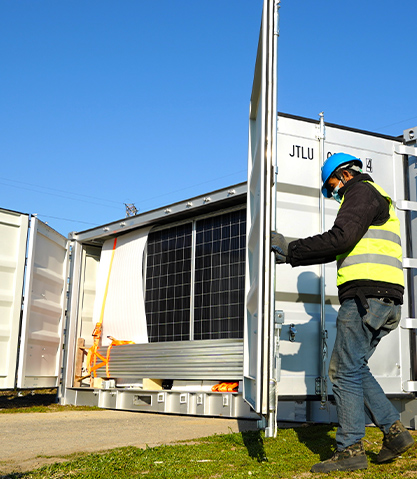
- Solar array deployment - Unfolding rooftop panels or installing separate ground arrays, making DC connections through weatherproof junction boxes, and orienting panels to optimize solar collection based on site latitude and seasonal sun angles for maximum annual energy production.
- Electrical interconnections - Connecting output cables to distribution panels or electrical service entrance, installing grounding systems meeting NEC Article 690 requirements, and implementing required disconnect switches and overcurrent protection per local electrical codes.
- System initialization - Powering up control systems, configuring battery management parameters, programming load priorities and operating schedules, and calibrating monitoring sensors ensuring accurate performance tracking and system protection.
- Performance verification - Conducting voltage and current measurements at all system points, performing load bank testing to verify rated capacity, checking safety systems including ground fault detection and arc fault protection, and documenting baseline performance metrics.
Commissioning procedures verify proper operation of all subsystems before transitioning to production mode. The battery bank undergoes initial charging to manufacturer's recommended state of charge, typically 50-80%, before enabling load connections. Solar array performance is verified through I-V curve tracing confirming panel outputs match manufacturer specifications and identifying any damaged or underperforming modules. Inverter testing confirms proper grid synchronization if applicable, verifying voltage and frequency regulation within specified tolerances, and validating anti-islanding protection preventing backfeed during grid outages. Control system testing exercises all operating modes including solar-only, battery discharge, generator backup, and load shedding scenarios ensuring automatic transitions occur correctly without disrupting critical loads.
Practical Applications and Use Cases
Mobile solar power containers serve diverse applications where conventional grid connections are unavailable, unreliable, or economically unfeasible. The construction industry deploys these systems to job sites requiring temporary power for tools, lighting, and site offices, eliminating diesel generator fuel costs, noise, and emissions while meeting increasingly stringent environmental regulations. A typical 20-foot container providing 20 kW continuous output can power construction trailers, battery charging stations, welding equipment, and portable tools while reducing operating expenses by 60-80% compared to diesel generators over multi-month projects. The mobility advantage enables contractors to relocate the power system between sequential job sites, amortizing capital costs across multiple projects.
Disaster response and emergency management organizations utilize mobile solar containers for rapid power restoration following hurricanes, earthquakes, floods, or other catastrophic events disrupting electrical infrastructure. These units provide immediate power for emergency operations centers, medical facilities, communications equipment, and water treatment systems while traditional grid repairs proceed. The self-contained design eliminates dependency on fuel supply chains that may be disrupted during disasters, with battery storage ensuring continuous operation through nighttime hours. Multiple containers can interconnect creating temporary microgrids serving entire communities, with documented deployments successfully powering hospitals, emergency shelters, and critical infrastructure for weeks or months during grid restoration efforts.
Specialized Industry Applications
- Mining and resource extraction - Providing power for remote exploration camps, drilling operations, and processing equipment in locations hundreds of miles from electrical infrastructure, with hybrid solar-diesel configurations reducing fuel consumption by 50-70% and lowering logistics costs in access-limited areas.
- Telecommunications - Supporting cellular tower sites, microwave relay stations, and network equipment in off-grid locations, with high-reliability configurations achieving 99.9% uptime through redundant battery banks and backup generation meeting carrier service level requirements.
- Military and defense - Powering forward operating bases, command posts, and surveillance systems with silent operation reducing acoustic signatures, eliminating vulnerable fuel convoys, and providing energy independence in hostile or austere environments for extended deployment periods.
- Events and entertainment - Supplying power for outdoor concerts, festivals, sporting events, and film productions requiring clean, quiet electricity incompatible with diesel generators, with scalable configurations supporting events from small gatherings to major productions consuming hundreds of kilowatts.
- Agricultural operations - Powering irrigation pumps, climate control systems, and processing equipment for farms and ranches in rural areas with unreliable grid service or time-of-use rates making peak demand expensive, using solar generation and battery storage to shift electrical consumption away from high-cost periods.
International development projects employ mobile solar containers for rural electrification in developing regions lacking electrical infrastructure. Village-scale installations consisting of multiple interconnected containers create community microgrids providing electricity for homes, schools, health clinics, and small businesses. The modular approach allows incremental capacity expansion as electrical demand grows, with initial installations serving essential loads before expanding to general residential and commercial service. These systems often incorporate prepaid metering enabling cost recovery while ensuring affordable access, with documented projects in Africa, Asia, and Latin America successfully providing reliable electricity to communities previously dependent on kerosene lamps, disposable batteries, and small gasoline generators.
Economic Analysis and Financial Considerations
The financial viability of mobile solar power containers depends on several factors including system capital cost, displaced energy costs, operational expenses, and deployment duration. Initial investment for turnkey systems ranges from $50,000 to $500,000 depending on capacity, component quality, and included features, translating to approximately $2,500 to $5,000 per installed kilowatt for complete containerized solutions. This capital cost compares favorably to permanent solar installations when considering the included battery storage, power electronics, and weatherproof enclosure that would require separate procurement in conventional systems, plus the added value of mobility enabling redeployment to alternative sites.
Operational cost savings relative to diesel generators provide the primary economic driver for many applications. Diesel generators consume 0.25 to 0.35 gallons per kWh of electricity produced at typical loading levels, creating fuel costs of $1.00 to $1.50 per kWh at recent diesel prices. A mobile solar container generating 50,000 kWh annually eliminates $50,000 to $75,000 in fuel purchases while reducing maintenance requirements associated with generator oil changes, filter replacements, and engine overhauls. The payback period for sites with high diesel fuel costs or difficult logistics typically ranges from 3 to 6 years, improving to 2 to 4 years when accounting for avoided generator replacement costs and environmental compliance expenses.
Total Cost of Ownership Factors
- Battery replacement costs - Lithium battery banks typically require replacement after 8-12 years representing 30-40% of initial system cost, though declining battery prices and improving cycle life are extending service intervals and reducing long-term ownership costs.
- Transportation and mobilization - Shipping costs vary from $2,000 to $10,000 per move depending on distance and logistics complexity, favoring applications with extended deployment periods amortizing mobilization costs over years rather than weeks or months of operation.
- Insurance and permits - Annual insurance premiums typically cost 1-2% of system value covering equipment damage, liability, and business interruption, while electrical permits and interconnection fees add $1,000 to $5,000 depending on jurisdiction and voltage level.
- Maintenance and monitoring - Preventive maintenance including panel cleaning, connection inspection, and battery testing requires 10-20 hours annually, with remote monitoring service subscriptions costing $500 to $2,000 per year enabling proactive issue identification and resolution.
- Resale value retention - Well-maintained mobile solar containers retain 40-60% of original value after 10 years of service, providing residual asset value or enabling cost recovery through resale when project requirements change or technology upgrades are desired.
Financing options including equipment leasing, power purchase agreements, and energy-as-a-service models reduce upfront capital requirements while enabling immediate operational savings. Lease structures typically require 10-20% down payment with monthly payments over 5-7 year terms, improving project cash flow for organizations with limited capital budgets. Power purchase agreements allow third-party ownership of the container system with the site purchasing generated electricity at fixed rates below diesel or grid costs, eliminating capital expenditure while guaranteeing energy savings. These alternative financial structures have expanded mobile solar container adoption across sectors including government, non-profit, and commercial entities previously unable to justify capital purchases.
Maintenance Requirements and Service Procedures
Mobile solar power containers require systematic maintenance preserving system performance and maximizing equipment service life. The maintenance program encompasses daily automated monitoring, periodic inspection and testing, and scheduled component replacement following manufacturer recommendations. Preventive maintenance intervals are typically structured as monthly visual inspections, quarterly detailed examinations, and annual comprehensive testing including thermal imaging, insulation resistance measurements, and battery capacity verification. Remote monitoring systems provide continuous surveillance of critical parameters including solar production, battery voltage and current, inverter operation, and system alarms, enabling immediate response to abnormal conditions before minor issues escalate into major failures.
Solar panel maintenance primarily involves periodic cleaning removing accumulated dust, pollen, bird droppings, and other contaminants reducing light transmission and generation capacity. Soiling losses vary from 2-5% in clean environments to 20-30% in dusty or agricultural areas, with cleaning frequency ranging from monthly in high-soiling locations to semi-annually in clean environments. Panel washing uses deionized water applied with soft brushes or automated cleaning systems, avoiding abrasive materials or high-pressure sprays that damage anti-reflective coatings. Visual inspections identify physical damage including cracked glass, delamination, or junction box corrosion requiring panel replacement. Infrared thermography detects hot spots indicating cell damage or connection problems, enabling targeted repairs preventing progressive degradation.
Battery System Maintenance Protocols
- State of health monitoring - Monthly capacity testing measuring actual amp-hour capacity against rated specifications, with capacity retention below 80% indicating approaching end-of-life requiring replacement planning to prevent unexpected failures.
- Cell balancing verification - Checking individual cell or module voltages ensuring balanced charge distribution, with voltage variations exceeding 50 millivolts indicating weak cells or balance system malfunction requiring investigation and potential module replacement.
- Thermal management inspection - Verifying proper operation of cooling fans, heat exchangers, and temperature sensors maintaining battery temperatures within optimal range, cleaning air filters and heat exchanger fins removing dust accumulation restricting airflow.
- Connection torque verification - Annually checking and re-torquing battery terminal connections to manufacturer specifications, preventing resistive heating from loose connections that damages terminals and reduces system efficiency.
- Equalization charging - Performing controlled overcharge cycles quarterly for lead-acid batteries preventing sulfation and balancing cell voltages, though modern lithium systems typically eliminate equalization requirements through integrated balancing circuits.
Inverter and power electronics maintenance includes firmware updates implementing performance improvements and bug fixes, connection inspections ensuring secure terminations at all power points, and cooling system verification confirming proper fan operation and heat sink cleanliness. Electrical testing measures voltage and current at rated load conditions verifying continued compliance with output specifications, while efficiency testing identifies degradation indicating component aging or pending failure. Control system batteries providing backup power for monitoring and shutdown procedures require replacement every 3-5 years maintaining emergency capability. Environmental control system maintenance encompasses HVAC filter replacement, refrigerant charge verification, and condensate drain cleaning preventing moisture accumulation that promotes corrosion and electrical tracking failures.
Safety Standards and Regulatory Compliance
Mobile solar power containers must comply with electrical safety standards, transportation regulations, and environmental codes ensuring safe operation and legal deployment. Electrical system design follows National Electrical Code Article 690 for solar photovoltaic systems and Article 706 for energy storage systems in the United States, or equivalent international standards including IEC 62548 and IEC 62933. These standards specify requirements for conductor sizing, overcurrent protection, disconnecting means, grounding, and arc fault protection preventing electrical hazards including shock, fire, and arc flash incidents. Professional engineering certification verifies design compliance, while field inspections by authorities having jurisdiction confirm installation quality before authorizing energization.
Battery safety considerations receive particular attention due to thermal runaway risks associated with lithium-ion energy storage. System designs incorporate multiple protection layers including cell-level monitoring, module-level fusing, battery management system controls, and container-level fire suppression systems creating defense-in-depth protection. Thermal runaway detection employs temperature sensors and smoke detectors triggering automatic battery disconnect and activating suppression systems before fire propagation. Modern suppression systems utilize clean agent gases or aerosol generators specifically designed for lithium battery fires, avoiding water-based systems that prove ineffective and potentially dangerous with energized electrical equipment.
Transportation and Handling Safety
- Hazardous materials compliance - Lithium batteries exceeding 100 Wh individual capacity fall under IATA Dangerous Goods or DOT Hazmat regulations requiring special placarding, documentation, and handling procedures during air or ground transportation between deployment sites.
- Structural certification - Container modifications including roof penetrations, equipment mounting points, and door alterations must maintain structural integrity meeting ISO 1496 standards for lifting, stacking, and transport loading preventing collapse or damage during handling.
- Weight distribution - Equipment placement within container must maintain proper center of gravity and corner loading limits preventing tipping during crane lifts or instability during transport, with gross weight clearly marked on container exterior.
- Securing and bracing - Internal equipment must be structurally attached withstanding 2g acceleration forces in all directions preventing shifting during transport that could damage components or create safety hazards when container is opened.
- Pre-transport preparation - Batteries should be discharged to 30-50% state of charge reducing energy content and fire risk, with all connections verified secure and protective covers installed over exposed terminals preventing short circuits.
Environmental regulations increasingly govern mobile power generation systems, with emissions standards, noise limits, and renewable energy incentives influencing deployment decisions. While solar containers produce zero direct emissions during operation, permitting authorities may still require environmental assessments for larger installations evaluating visual impact, land use, and decommissioning plans. Noise regulations typically exempt solar containers lacking generators, though inverter and cooling system noise must be evaluated for sites adjacent to noise-sensitive receptors. Incentive programs including investment tax credits, accelerated depreciation, and renewable energy credits improve project economics, though mobile systems may face restrictions compared to permanent installations depending on specific program rules and eligibility criteria.
Future Developments and Technology Trends
The mobile solar power container industry continues evolving through advancements in component technology, system integration, and digital capabilities. Next-generation solar panels incorporating bifacial cells, passivated emitter rear contact technology, and tandem perovskite-silicon architectures promise efficiency improvements from current 20-22% levels to 28-32% within the next five years, increasing power density and reducing required panel area. Advanced battery technologies including solid-state lithium, lithium-sulfur, and flow battery systems offer higher energy density, improved safety characteristics, and extended cycle life potentially doubling storage capacity within equivalent weight and volume constraints while reducing fire risks associated with current liquid electrolyte lithium-ion technologies.
Artificial intelligence and machine learning integration enhances system performance through predictive maintenance, optimal dispatch strategies, and adaptive control responding to usage patterns and weather forecasts. AI algorithms analyze historical performance data identifying anomalous behavior indicating developing failures before critical components stop functioning, enabling proactive maintenance reducing unplanned downtime. Load forecasting models combined with solar production predictions optimize battery charging and discharging schedules maximizing renewable energy utilization while ensuring sufficient reserve capacity for critical loads. These intelligent systems reduce operating costs by 10-20% through improved efficiency and reduced maintenance expenses while increasing system reliability and extending component service life.
Emerging Integration Capabilities
- Hydrogen integration - Adding electrolyzers producing hydrogen from excess solar generation and fuel cells reconverting hydrogen to electricity during extended low-solar periods, enabling seasonal energy storage beyond lithium battery capabilities for ultra-reliable off-grid applications.
- Vehicle-to-grid connectivity - Bidirectional charging interfaces allowing electric vehicles to function as mobile battery banks connecting to container systems, expanding effective storage capacity and enabling energy sharing between transportation and stationary applications.
- Microinverter architectures - Module-level power electronics maximizing energy harvest from partially shaded panels, enabling more flexible panel layouts, and providing detailed performance monitoring identifying underperforming modules requiring attention or replacement.
- Blockchain energy trading - Peer-to-peer energy marketplaces enabling multiple mobile solar containers to automatically buy and sell excess generation optimizing community microgrid economics and incentivizing strategic deployment locations supporting grid stability.
- Autonomous deployment systems - Robotic installation mechanisms automatically deploying solar arrays, establishing electrical connections, and performing commissioning procedures reducing deployment time from days to hours and eliminating skilled technician requirements for routine installations.
Standardization initiatives through organizations including the International Electrotechnical Commission, Institute of Electrical and Electronics Engineers, and industry consortiums are developing common specifications for containerized energy storage systems ensuring interoperability, safety consistency, and performance transparency. These standards facilitate multi-vendor deployments, simplify permitting processes, and reduce insurance costs through demonstrated compliance with recognized safety requirements. Market growth projections forecast the mobile solar container sector expanding from approximately $500 million current annual revenue to over $2 billion within the next decade, driven by declining component costs, increasing diesel fuel prices, expanding renewable energy mandates, and growing recognition of energy security benefits provided by distributed, mobile power generation capabilities.
