

 en
en  English
 中文简体
中文简体 عربى
عربى
Content
- 1 DC vs AC Solar Distribution Box: Two Roles in One System
- 2 Core Components Inside a Solar Distribution Box
- 3 IP Rating, Enclosure Material, and Mounting Options
- 4 Solar Distribution Box in Off-Grid and Containerized Systems
- 5 Key Specifications Comparison: DCDB vs ACDB
- 6 Choosing a Reliable Solar Distribution Box Supplier
DC vs AC Solar Distribution Box: Two Roles in One System
A solar power system moves electricity through two fundamentally different states — direct current from the panels, and alternating current after the inverter. The solar distribution box that manages each stage is not the same device, and treating them as interchangeable is one of the most common specification errors in PV installations.
The DC Distribution Box (DCDB) sits between the solar array and the inverter. It receives DC power from one or multiple string combiner outputs, routes it through protection devices, and delivers a controlled DC feed to the inverter input. Everything upstream of the inverter — panel strings, combiner outputs, DC cabling — is managed here. The enclosure must be rated for DC-specific hazards, including sustained arc faults and unidirectional current flow that standard AC breakers cannot safely interrupt.
The AC Distribution Box (ACDB) operates downstream of the inverter. It receives the converted AC output and distributes it to loads, grid tie points, or an AC distribution panel. Its internal components — surge protection devices, MCBs or MCCBs — are specified for AC voltage and current profiles, which behave very differently from their DC counterparts under fault conditions. In three-phase commercial or industrial systems, the ACDB also handles phase balancing and metering integration.
Both boxes are necessary in any complete grid-tied or hybrid system. Skipping either — or substituting a general-purpose electrical enclosure — compromises protection at the most vulnerable transition points in the power chain.
Core Components Inside a Solar Distribution Box
The protection profile of a solar distribution box is defined by four primary components. Each plays a distinct role, and the selection of each directly determines how the box performs under fault, surge, and overload conditions.
MCB / MCCB (Miniature or Molded Case Circuit Breaker) provides overcurrent and short-circuit protection. In DCDB applications, DC-rated MCBs are mandatory — standard AC breakers cannot reliably extinguish a DC arc and will fail catastrophically under fault current. Rated current is typically selected at 1.25× the maximum continuous operating current of the circuit it protects. For high-current industrial strings, MCCBs with adjustable trip settings replace MCBs.
SPD (Surge Protection Device) protects downstream equipment — inverters, charge controllers, and batteries — against voltage transients caused by lightning strikes, grid switching events, and induced surges from nearby high-voltage equipment. DC-side SPDs are specified per IEC EN 50539-11, which defines requirements specifically for photovoltaic DC applications. AC-side SPDs handle grid-originated transients. In both cases, the SPD clamps excess voltage to a safe level and diverts the energy to earth.
DC Isolator Switch creates a visible, lockable disconnection point in the DC circuit. This is not a protective device in the overcurrent sense — its function is operational safety: allowing technicians to safely de-energize the DC side during maintenance, commissioning, or fault investigation without relying on the inverter's internal shutdown. Most regulatory frameworks require a dedicated DC isolator accessible from ground level or the equipment cabinet.
Fuses provide string-level overcurrent protection in multi-string arrays, particularly where reverse current from parallel strings could exceed a single string's cable or connector ratings. String fuses are installed at the positive input of each string within the DCDB, and their ratings must account for both the maximum string current and the maximum reverse current from parallel strings under worst-case fault conditions.
IP Rating, Enclosure Material, and Mounting Options
The enclosure that houses these components is not a passive container — its material, ingress protection rating, and mounting configuration directly determine whether the distribution box survives its operating environment over the system's 20–25 year design life.
IP65 vs IP67. IP65 is the standard minimum for outdoor solar applications: fully dust-tight and protected against low-pressure water jets from any direction. It covers the vast majority of rooftop and ground-mount installations in temperate and tropical climates. IP67 — protection against temporary immersion up to one meter — is specified for flood-prone sites, coastal installations subject to wave splash, and containerized systems deployed in challenging field conditions where the enclosure may be exposed to standing water during transport or setup. The international standard governing PV array design, IEC 62548-1:2023, which sets out DC array wiring and electrical protection device requirements, provides the framework within which enclosure ratings and protection component specifications must be selected.
Enclosure material choices balance cost, weight, and environmental resistance. Thermoplastic polycarbonate (PC) enclosures are lightweight, UV-stabilized, and corrosion-free — well suited for rooftop and wall-mounted DCDBs in most climates. Powder-coated steel or stainless steel is specified for industrial ground-mount and containerized deployments where physical impact resistance and long-term dimensional stability matter more than weight. In salt-laden coastal environments, 316-grade stainless steel or GRP (glass-reinforced polyester) enclosures are preferred over standard carbon steel regardless of coating quality.
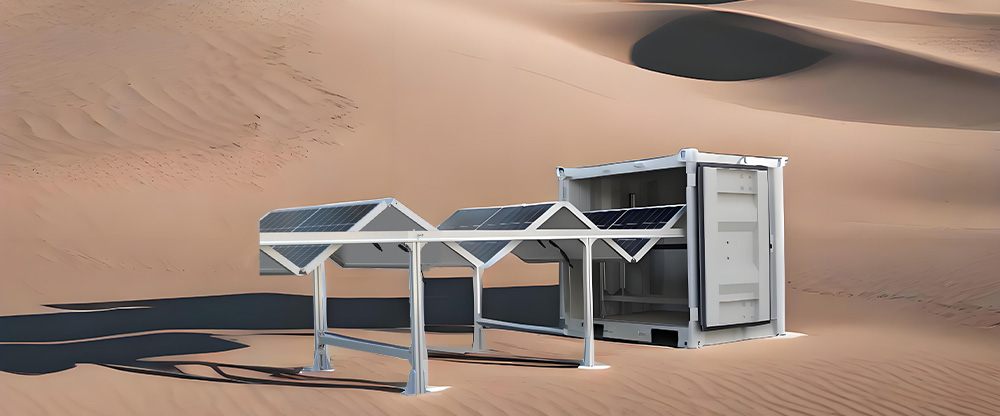
Mounting configurations vary by installation type. Wall-mounted enclosures are standard for rooftop residential and small commercial systems, positioned near the inverter to minimize DC cable run length. Pole-mounted configurations suit ground-mount utility projects where no adjacent wall surface exists. Free-standing floor-mounted cabinets are used in large industrial systems where multiple DCDBs or a combined DCDB/ACDB assembly must be accessible at working height without scaffolding. For containerized and mobile solar deployments, integrated panel-mounted distribution assemblies are recessed into the container wall, protected from impact and accessible via a hinged front panel.
Solar Distribution Box in Off-Grid and Containerized Systems
Grid-tied rooftop solar places the distribution box in a relatively controlled environment — fixed location, stable ambient temperature, predictable load profile. Off-grid and containerized solar systems operate under entirely different conditions, and the distribution box specification must reflect that.
In remote mining, oil field, and telecommunications deployments, the distribution box is part of a self-contained power plant that may be operated and maintained by personnel without specialist electrical training. This changes the design priorities significantly: visible fault indication, clearly labeled isolation points, and simplified internal layouts reduce the risk of errors during field maintenance. Enclosures must withstand dust loading from unpaved sites, vibration from nearby heavy equipment, and temperature cycling between cold nights and high daytime ambient temperatures that exceed the ratings of components selected for standard residential applications.
Military and emergency response deployments add the requirement for rapid setup and teardown. Distribution boxes in these systems must support tool-free cable connections where possible, and the enclosure itself must survive transport in standard shipping configurations without internal component damage. For island, port, and marine applications, salt spray resistance and corrosion-proof hardware are non-negotiable — a distribution box specified for inland China is unlikely to survive two seasons on a coastal island site in Southeast Asia or the Middle East.
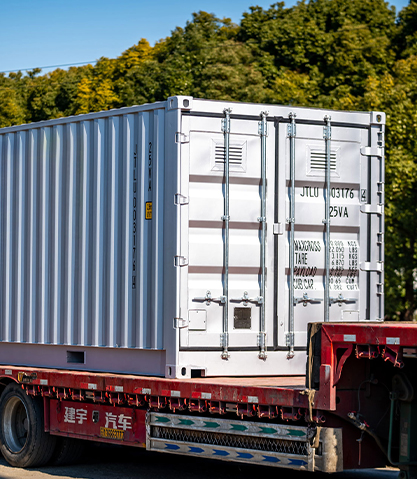
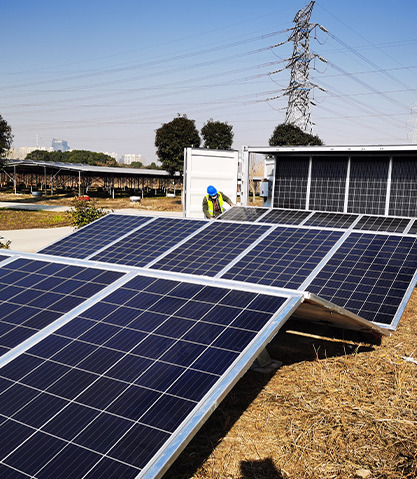
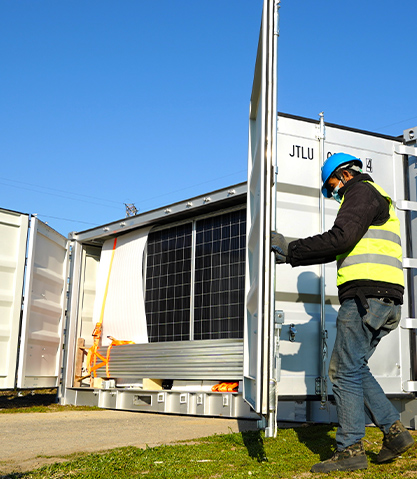
Senta Energy's containerized solar power box systems designed for off-grid deployment are engineered specifically for these demanding environments, integrating the distribution function within a hardened, transport-ready enclosure that maintains full protection-device functionality across the deployment scenarios Senta serves globally. These systems work in conjunction with Senta's solar power containers for remote and industrial sites, where the distribution box, inverter, and array control functions are co-located within a single deployable unit — eliminating the field-assembly risks that arise when components from different suppliers must be integrated on site. For projects that combine generation with storage, battery ESS container systems for integrated energy storage connect directly to the solar distribution assembly, with DC-side protection coordinated across both generation and storage circuits.
Key Specifications Comparison: DCDB vs ACDB
The following table summarizes the primary specification differences between DC and AC solar distribution boxes to support procurement and system design decisions.
| Parameter | DC Distribution Box (DCDB) | AC Distribution Box (ACDB) |
|---|---|---|
| System position | Between PV array / combiner and inverter | Between inverter output and loads / grid |
| Voltage range | Typically 600–1500V DC | Single-phase 230V / Three-phase 400V AC |
| Circuit breaker type | DC-rated MCB / MCCB mandatory | Standard AC MCB / MCCB |
| SPD standard | IEC EN 50539-11 (DC PV application) | IEC 61643-11 (AC low-voltage SPD) |
| Isolation requirement | DC isolator switch (visible break) | AC isolator or main switch |
| String fuse requirement | Required for multi-string arrays | Not applicable |
| Monitoring options | String current monitoring, insulation monitoring | Energy metering, power quality monitoring |
| Typical enclosure rating | IP65 minimum (IP67 for harsh sites) | IP65 outdoor / IP54 indoor |
Choosing a Reliable Solar Distribution Box Supplier
A solar distribution box is a long-service-life component. The system it protects may operate for 25 years or more — and the distribution box must outlast not just the panels, but also the maintenance cycles, personnel changes, and regulatory updates that occur over that period. Choosing a supplier on initial unit price alone is a short-term calculation with long-term consequences.
The technical capabilities that distinguish a reliable supplier are specific: in-house R&D that can adapt protection configurations to non-standard system voltages and string counts; manufacturing quality systems that ensure component ratings are consistent between sample and production units; and certification to IEC and ISO standards that provides independent verification of those claims. Senta Energy holds more than 40 patents — including 7 invention patents — alongside ISO certifications and over 60 registered trademarks, reflecting sustained investment in both product development and quality management across its solar power systems product range.
For projects where the distribution box must integrate with a larger system architecture, supplier capability in system-level engineering matters as much as the box specification itself. Senta's complete solar power solutions and documented project cases across mining, military, maritime, agricultural, and industrial applications demonstrate the ability to engineer distribution and protection functions into complete, deployment-ready systems — rather than supplying a component and leaving integration to the customer. That distinction is the relevant one for EPC contractors and system integrators evaluating suppliers for complex off-grid or containerized solar projects. Supporting solar power kits and system components sourced from the same engineering team further reduces compatibility risk across the full installation.
