
 en
en  English
 中文简体
中文简体 عربى
عربى
Content
- 1 What a Solar Power Container Is and Why It Changes Energy Deployment
- 2 The Mobile Solar Power Container: Engineered for Rapid Relocation
- 3 Solar Fold Mobile Grid: Maximizing Panel Capacity Within a Compact Form
- 4 Integrated System Architecture and Key Technical Components
- 5 Scalable and Modular Deployment for Growing Power Demands
- 6 Customizable Configurations for Multi-Scene Applications
What a Solar Power Container Is and Why It Changes Energy Deployment
A solar power container is a fully integrated, self-contained energy system built within a standard shipping container frame — typically 20-foot or 40-foot ISO dimensions — that houses solar panels, battery storage, inverters, charge controllers, and monitoring systems in a single transportable unit. Unlike conventional solar installations that require extensive civil works, grid interconnection studies, and weeks of on-site assembly, a solar power container arrives at its destination as a factory-tested, ready-to-operate system. The plug-and-play design philosophy means that once the unit is positioned and the solar array is deployed, the system can be generating and delivering usable power within hours rather than weeks.
This approach addresses one of the most persistent barriers to solar adoption in remote, temporary, or rapidly changing deployment environments: the gap between when power is needed and when a conventional installation can realistically be commissioned. Emergency response operations, construction sites, mining camps, military forward operating bases, and rural electrification projects all share the characteristic that power demand is immediate, the site may not be permanent, and the logistics of conventional grid connection are either too slow or entirely impractical. The solar power container collapses that gap by pre-integrating everything at the factory level, where quality control, system testing, and performance verification can be conducted under controlled conditions before the unit ever reaches the field.
The Mobile Solar Power Container: Engineered for Rapid Relocation
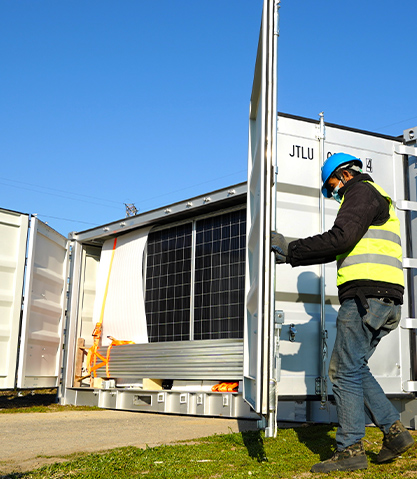
The mobile solar power container takes the core concept a step further by prioritizing repeated deployment and relocation as a primary design requirement rather than an afterthought. Standard solar power containers are transportable, but mobile variants are specifically engineered for frequent movement — with reinforced structural frames rated for multiple transport cycles, quick-connect electrical interfaces, and solar array mounting systems designed to fold down, secure, and redeploy without specialized tools or skilled labor beyond a basic operational crew.
Mobility at this level makes the mobile solar power container a genuinely multi-scene solution. The same unit can serve a disaster relief staging area in month one, relocate to support a seasonal agricultural operation in month three, and move again to power a remote telecommunications relay station by year's end — all without any modification to the core system. This asset utilization model is fundamentally different from fixed solar installations, where capital expenditure is locked to a single site for the system's entire 20–25 year lifespan. For organizations managing energy infrastructure across multiple temporary or semi-permanent sites, the ability to redeploy a high-value solar asset where it is most needed transforms the economics of off-grid power delivery.
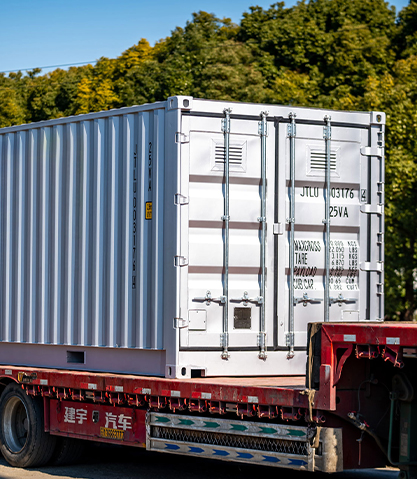
Transport compatibility is a key practical feature of well-designed mobile solar power containers. Conformance to ISO container dimensions means the unit can be moved by standard flatbed truck, loaded onto cargo ships without special handling equipment, or airlifted by heavy-lift helicopter for truly remote deployments. This interoperability with global freight infrastructure dramatically expands the range of accessible deployment locations compared to purpose-built trailer-mounted systems that require specialized transport permits and equipment.
Solar Fold Mobile Grid: Maximizing Panel Capacity Within a Compact Form
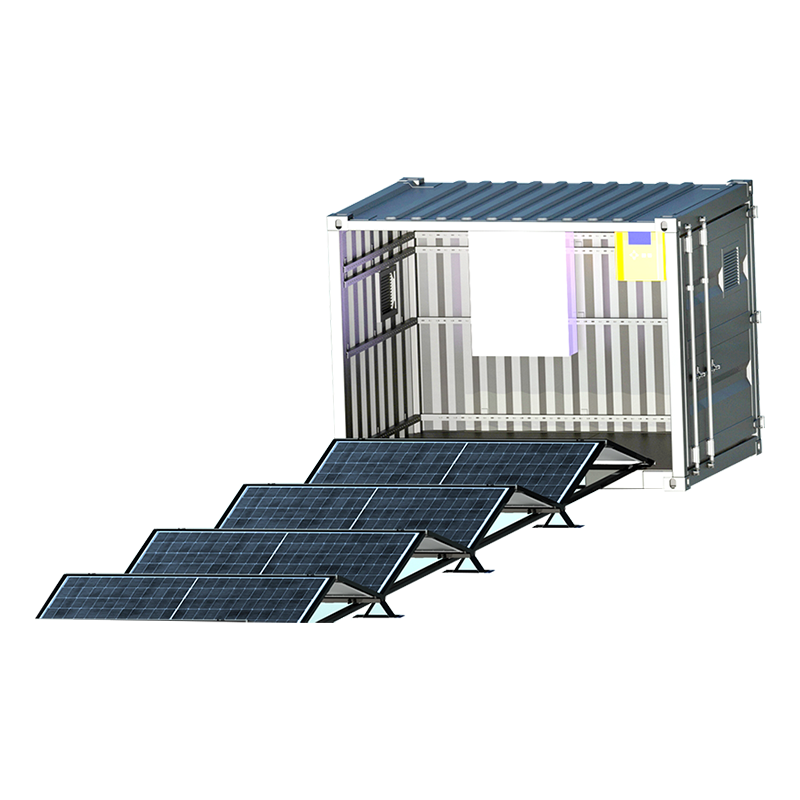
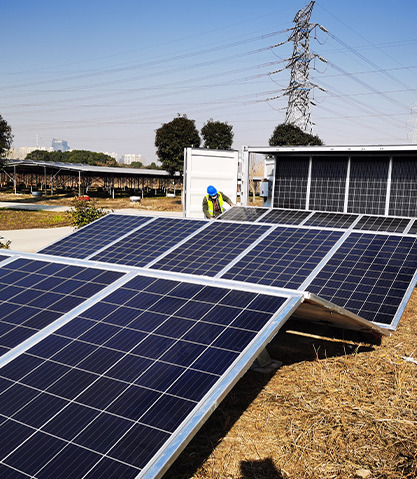
The solar fold mobile grid is a specific panel deployment architecture used in advanced mobile solar power containers to dramatically increase the solar capture area relative to the container's footprint. Rather than limiting panel installation to the container roof — which constrains capacity to the roof area alone — the solar fold mobile grid uses mechanically or hydraulically actuated folding panel arrays that extend outward from the container's sides and ends when deployed, then fold flat against the container body for transport.
A well-engineered solar fold mobile grid on a 40-foot container can deploy panel arrays covering three to four times the container's ground footprint, enabling installed solar capacities of 30 kWp to 80 kWp or more from a single containerized unit — a range that supports meaningful load coverage for small communities, industrial processes, or telecom infrastructure without requiring separate ground-mount panel installations that add civil works complexity and site preparation time. The folding mechanism is designed for ease of operation by a two-person crew using either integrated electric actuators or manual crank systems, with locking pins that secure the array in both deployed and transport configurations.
The solar fold mobile grid design also allows for optimized panel tilt angle adjustment during deployment, so operators can set the array angle appropriate to the site's latitude for maximum annual energy yield rather than accepting the fixed-angle compromise of roof-mounted panels. This combination of expanded area and adjustable orientation makes the solar fold mobile grid a significantly more capable energy harvesting system than static container roof configurations.
Integrated System Architecture and Key Technical Components
The practical performance of any solar power container depends on how well its internal components are integrated into a coherent, reliable system. Factory integration means that wiring, protection devices, communication buses, and control software are all configured and tested as a complete system — not assembled piece by piece on site where installation errors, grounding faults, and configuration mismatches introduce reliability risks. The following components form the core of a fully integrated solar power container system:
- Solar PV modules: Monocrystalline PERC or TOPCon panels rated at 400W–600W per module are standard in current-generation systems, offering high efficiency in a compact form factor. Panels are pre-wired into strings with MC4 connectors that terminate at the container's internal combiner box.
- Battery energy storage system (BESS): Lithium iron phosphate (LiFePO4) battery banks are the dominant chemistry due to their thermal stability, cycle life exceeding 4,000 full cycles, and safety profile in enclosed container environments. Typical capacities range from 50 kWh to 500 kWh depending on the container size and application requirements.
- Hybrid inverter and charge controller: A bidirectional inverter manages power flow between the solar array, battery bank, AC loads, and optional grid or generator connections. MPPT charge controllers optimize energy harvest from the solar array across varying irradiance and temperature conditions throughout the day.
- Energy management system (EMS): The EMS software layer monitors all system parameters in real time, manages charge and discharge cycles to extend battery life, handles load prioritization during low-state-of-charge conditions, and communicates operational data to remote monitoring platforms via 4G/LTE or satellite.
- Thermal management and ventilation: Active cooling systems maintain battery and inverter temperatures within optimal operating ranges, which is critical for performance in high-ambient-temperature deployment environments such as desert regions or tropical climates.
Scalable and Modular Deployment for Growing Power Demands
One of the most strategically valuable characteristics of the solar power container platform is its inherently scalable and modular architecture. A single container unit can operate as a standalone microgrid serving a small load. When demand grows — or when a project phase requires significantly more capacity — additional container units can be connected in parallel to expand total solar generation, battery storage, and AC output proportionally, without replacing or modifying the existing installation. This modular expansion model allows operators to start with a right-sized initial investment and add capacity incrementally as load growth justifies the expenditure.
The scalable nature of this architecture is particularly well suited to sustainable development contexts, where initial community energy needs may be modest but expected to grow as economic activity develops around reliable power access. Rather than sizing a large fixed installation for projected future demand and accepting years of underutilized capacity, project developers can deploy a single mobile solar power container as the first phase and expand with additional units as actual demand data justifies the investment.
| Configuration | Solar Capacity | Battery Storage | Typical Application |
|---|---|---|---|
| Single 20ft unit | 15–30 kWp | 50–100 kWh | Small camp, telecom relay, emergency response |
| Single 40ft unit (fold grid) | 40–80 kWp | 150–300 kWh | Mining site, rural microgrid, military base |
| Multi-unit array (3–5 containers) | 150–400 kWp | 500 kWh–1.5 MWh | Island grid, industrial process, event power |
Customizable Configurations for Multi-Scene Applications
While the standard solar power container format serves a broad range of applications effectively, the most capable suppliers offer genuinely customizable system configurations that allow buyers to specify the exact combination of generation capacity, storage size, output voltage and frequency, communication interfaces, and structural features required for their specific deployment context. This customizable approach is what transforms the solar power container from a generic product into a purpose-engineered solution for demanding operational environments.
Common customization parameters include output voltage configuration (single-phase 230V, three-phase 400V, or custom voltage for specific industrial loads), generator integration interfaces for hybrid diesel-solar operation, shore power input for grid-tied backup modes, IP-rated external connection panels for harsh weather environments, and interior layout modifications to accommodate additional equipment such as water pumps, lighting panels, or communications racks within the container enclosure. For multi-scene operators managing deployments across diverse geographic and climatic conditions, specifying appropriate thermal management for both arctic and tropical temperature ranges within the same unit design ensures the asset performs reliably across its full range of potential deployment locations without requiring site-specific modifications.
The sustainable energy credentials of the solar power container platform are strengthened considerably when the customizable design enables true diesel displacement rather than merely supplementing existing generator sets. Systems engineered with sufficient battery storage depth to cover overnight loads and early-morning peak demand periods — combined with a solar fold mobile grid sized to fully recharge the battery bank from typical daily irradiance — can achieve diesel fuel savings exceeding 80% compared to generator-only operation, delivering both significant operating cost reductions and measurable carbon emission reductions that support corporate sustainability reporting and project environmental compliance requirements.