

 en
en  English
 中文简体
中文简体 عربى
عربى
Most facility managers focus on reducing how much electricity they consume. Far fewer realize that a significant portion of their utility bill has nothing to do with consumption at all — it reflects how quickly their facility draws power during a single 15-minute window each month. That charge, the demand charge, is what peak shaving energy storage is specifically designed to address. And for commercial and industrial facilities, the savings potential is substantial.
Content
- 1 The Hidden Cost Driving Peak Shaving Adoption
- 2 How Peak Shaving with Battery Storage Works
- 3 Peak Shaving vs. Load Shifting: Key Differences
- 4 Sizing a Peak Shaving Energy Storage System
- 5 Industries and Facilities That Benefit Most
- 6 Combining Peak Shaving with Solar and Backup Power
- 7 ROI Analysis: When Does Peak Shaving Pay Off?
The Hidden Cost Driving Peak Shaving Adoption
Demand charges exist because utilities must maintain enough generation and grid capacity to serve their customers' highest possible consumption — even if that peak occurs only a few times per year. To recover the cost of this reserve capacity, they bill commercial and industrial customers based on the single highest 15-minute average power draw recorded during the billing period.
The result is a billing structure where a brief surge — a production line starting up, a large HVAC system engaging at full load, multiple high-power machines cycling simultaneously — can set the demand charge for the entire month. In commercial and industrial settings, demand charges routinely account for 30% to 70% of the total electricity bill, yet they reflect only a small fraction of actual operating hours.
Studies across C&I facilities show that peak shaving strategies consistently reduce total electricity costs by 10–40%, with the greatest savings at sites with variable, spiky load profiles and aggressive demand charge tariffs. A battery energy storage system (BESS) deployed for peak shaving converts this structural billing inefficiency into a predictable monthly cost reduction.
How Peak Shaving with Battery Storage Works
The mechanism is straightforward. A peak shaving energy storage system charges its battery bank during off-peak hours — typically overnight when grid tariffs are lowest — then automatically discharges stored power into the facility during periods of high demand. By supplementing grid supply with stored energy, the facility draws less peak power from the utility, reducing the recorded demand peak and lowering the demand charge accordingly.
The energy management system (EMS) at the core of the battery system does the analytical work. It continuously monitors the facility's real-time power consumption against a configurable demand threshold. When consumption approaches that threshold, the system begins discharging to keep the facility's grid draw below the target level. This process happens automatically, without any operational changes to the facility's equipment or production schedule.
The charge cycle is equally managed. Rather than drawing large amounts of grid power at random times, the EMS schedules charging for low-tariff windows — typically late night to early morning — maximizing the price differential between stored energy cost and peak-hour grid rates. In markets with significant time-of-use (TOU) pricing, this arbitrage adds a second layer of savings on top of demand charge reduction.
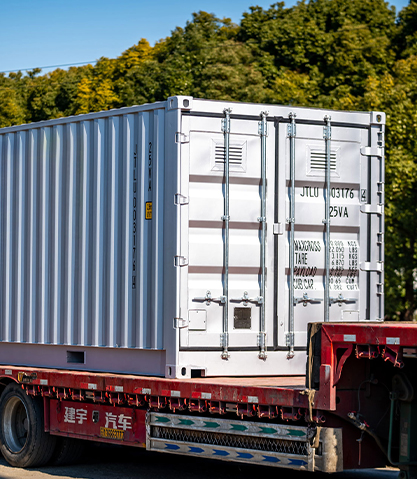
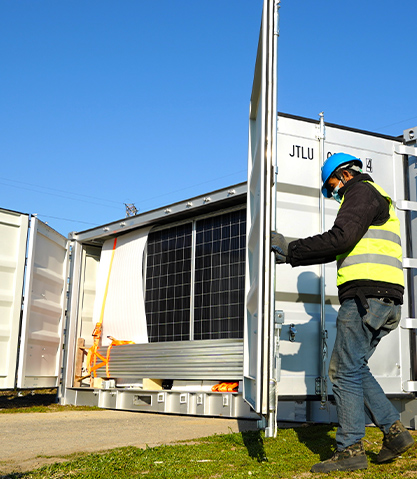
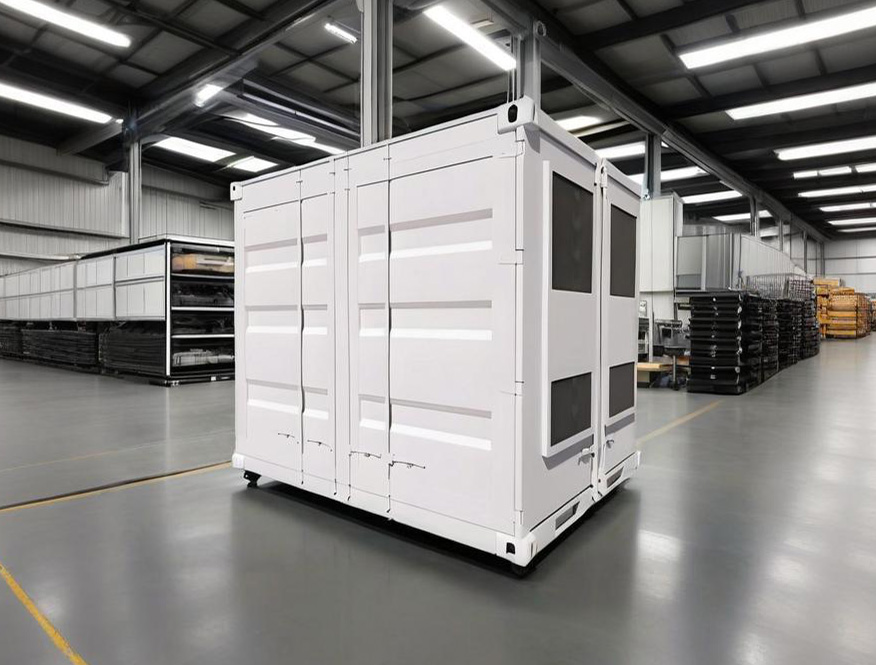
A containerized battery energy storage system for peak shaving applications integrates all of these components — battery modules, BMS, PCS, and EMS — into a single deployable unit, simplifying installation and commissioning for most commercial and industrial sites.
Peak Shaving vs. Load Shifting: Key Differences
These two strategies are often discussed together and sometimes confused, but they address different billing components and involve different system behaviors.
| Factor | Peak Shaving | Load Shifting |
|---|---|---|
| Primary target | Demand charge (kW-based fee) | Energy charge (kWh-based fee) |
| How it works | Discharge during demand spikes to cap grid draw | Move consumption from high-rate to low-rate hours |
| Load flexibility needed | None — system responds to grid draw automatically | Some loads must be reschedulable |
| Best for | Sites with unpredictable or unavoidable peak loads | Sites with schedulable processes and TOU tariffs |
| Savings driver | Reducing the highest 15-min demand reading | Buying cheap kWh, avoiding expensive kWh |
| Combined use | Most C&I storage systems do both simultaneously | |
In practice, the two strategies are not mutually exclusive. A well-configured peak shaving system also captures load-shifting arbitrage as a secondary benefit, because the same charge-at-night, discharge-at-peak behavior that manages demand also exploits TOU price differences. The storage hardware is identical; only the optimization logic and financial prioritization differ.
Sizing a Peak Shaving Energy Storage System
System sizing determines how much demand charge reduction is achievable and directly drives the investment return. Getting it right requires analysis of real facility data — not estimates.
The starting point is 12 months of 15-minute interval load data from the utility meter. This data reveals the pattern, frequency, and duration of demand peaks: Are peaks predictable (same time each production day) or random (triggered by equipment faults or weather)? How long do peak periods last — minutes or hours? How large is the gap between average demand and peak demand?
From this analysis, two sizing parameters emerge. The power rating (kW) must equal or exceed the demand reduction target — the gap between the facility's peak draw and the threshold the owner wants to hold below. The energy capacity (kWh) must be sufficient to sustain that discharge rate for the full duration of the peak period.
A practical example: a manufacturing facility with a 900 kW average demand that spikes to 1,250 kW for 45–60 minutes during morning startup needs a system rated at approximately 350 kW power output with 400–500 kWh of storage capacity to hold demand below 900 kW through that window. The battery inverter components for storage system configuration must be matched to this power rating for correct system assembly.
Modular containerized designs allow capacity to be added later without replacing existing equipment, which is particularly useful when facilities plan phased load increases or when budget constraints favor a staged investment approach.
Industries and Facilities That Benefit Most
Peak shaving delivers its greatest value where demand charges are highest, load profiles are spikiest, and operational constraints prevent reducing peak loads through scheduling changes alone.
Manufacturing facilities are the archetypal peak shaving candidate. Motor starts, press cycles, welding operations, and furnace heating create sharp, unavoidable load spikes. Production cannot be halted to manage demand, so storage is the only viable solution for reducing the peaks without constraining output.
Data centers run at high, relatively stable loads but experience surges during server provisioning, batch processing, and cooling system responses to temperature events. Demand charges on data center utility accounts are substantial, and the value of storage extends beyond peak shaving to include UPS functionality and backup power.
Electric vehicle charging infrastructure is emerging as one of the fastest-growing peak shaving applications. Fleet charging operations — charging 20, 50, or 100 vehicles simultaneously at a depot — create massive, concentrated demand spikes that would otherwise trigger prohibitive demand charges or require expensive grid upgrades. Storage absorbs those spikes, making fleet electrification economically viable.
Commercial buildings face HVAC-driven peaks, particularly in warm climates where afternoon cooling loads surge. Office complexes, shopping centers, and hotels with aggressive air conditioning loads in high-tariff markets see some of the shortest payback periods for peak shaving systems.
Hospitals and critical infrastructure combine the demand charge reduction motive with a mandatory backup power requirement, enabling a single storage investment to serve both purposes simultaneously.
Combining Peak Shaving with Solar and Backup Power
A standalone peak shaving system charges from the grid overnight and discharges during demand peaks. Pairing it with on-site solar generation fundamentally changes the economics — and the functionality.
Solar generation typically peaks between 10 AM and 2 PM. In many commercial facilities, this coincides with the beginning of the daily demand peak, not its resolution. Without storage, excess solar generation is either curtailed or exported at low feed-in rates. With storage, that midday solar surplus charges the battery directly, reducing grid charging costs to near zero and displacing the peak-hour grid draw with solar-charged stored energy.
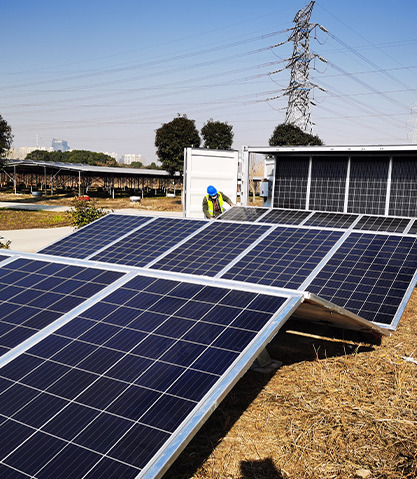
The combined solar-plus-storage system achieves three revenue streams simultaneously: demand charge reduction from peak shaving, energy cost reduction from TOU arbitrage, and reduced grid import from solar self-consumption. Solar power container systems integrated with battery storage are purpose-built for this combined deployment, with compatible control systems that optimize across all three revenue streams. The solar ESS container with integrated energy storage provides a fully packaged solution for grid-connected commercial and industrial sites.
Adding backup power capability requires only that the system's inverter supports island mode operation and that transfer switching is installed between the storage system, the critical loads, and the grid connection. The storage capacity already provisioned for peak shaving then serves double duty as emergency power reserve — at minimal additional cost over a peak-shaving-only system.
ROI Analysis: When Does Peak Shaving Pay Off?
The financial case for a peak shaving energy storage system hinges on three variables: the demand charge rate (USD/kW/month), the achievable demand reduction (kW), and the installed system cost. When these align favorably, payback periods of 4–7 years are achievable at current battery prices — and declining further as costs continue to fall.
Consider a straightforward example. A commercial facility in a market with a USD 15/kW demand charge achieves 250 kW of demand reduction through storage. The monthly savings from demand charges alone: USD 3,750 per month, USD 45,000 annually. Add TOU energy arbitrage at USD 0.08/kWh over 300 kWh daily cycles, and annual savings increase by approximately USD 8,760. Total annual benefit: approximately USD 53,760.
A 300 kW / 600 kWh system installed at USD 200/kWh — consistent with current market pricing — costs approximately USD 120,000. At USD 53,760 in annual savings, the simple payback period is under 2.5 years in this scenario. Real-world projects vary widely based on tariff structure, local battery pricing, installation complexity, and available incentives, but this example illustrates why the economics have shifted so decisively in favor of storage investment.
Markets with higher demand charges — California (USD 18–30/kW), Japan, Germany, and parts of Australia — offer faster payback. Markets with lower or flat-rate tariffs require longer horizons but often still make financial sense when backup power avoided costs are included in the analysis.
Businesses evaluating a peak shaving investment should begin with a detailed load data analysis and site energy audit. Reviewing the full commercial and industrial energy storage solutions portfolio helps identify the right system scale, configuration, and integration approach for each facility's specific financial and operational objectives.
