

 en
en  English
 中文简体
中文简体 عربى
عربى
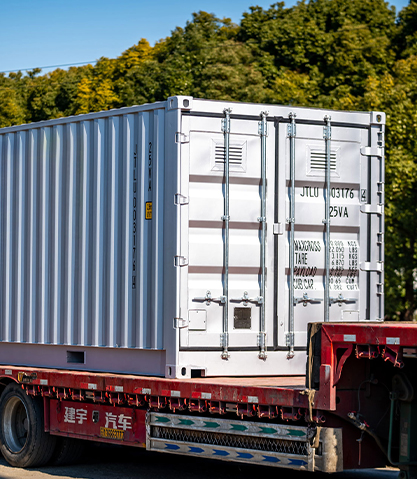
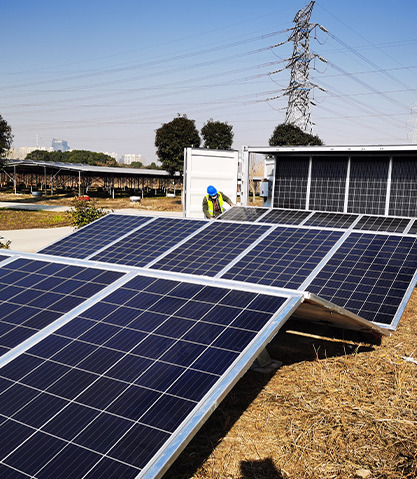
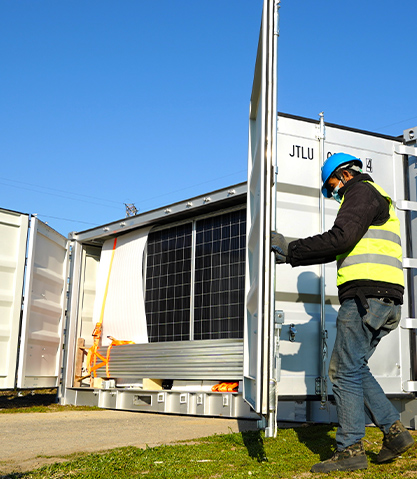
A mining contractor in West Africa needed 80 kW of reliable power at a new extraction site — 340 kilometers from the nearest grid connection. The options were a diesel generator fleet (expensive to fuel, expensive to maintain, requiring constant logistics support) or a solar installation (requiring weeks of civil work, local engineering, and commissioning time the project schedule couldn't absorb). Neither fit. What did fit was a pre-assembled solar container that arrived on site, unfolded its panels, and began generating electricity the same afternoon — no foundation work, no specialist electricians, no extended setup window.
That scenario is now repeating across mining, construction, humanitarian, and military operations worldwide. According to research from MarketsandMarkets, the solar container market is projected to grow from USD 0.29 billion in 2025 to USD 0.83 billion by 2030, driven by rising demand for portable, decentralized power in off-grid and remote environments. The technology making that growth possible is the plug-and-play modular solar container — and understanding exactly what that means in practice is the starting point for any serious procurement decision.
Content
- 1 The Case for Pre-Integrated Solar Power in the Field
- 2 What "Plug-and-Play" Actually Means in a Solar Container
- 3 Modular Architecture: From Single Unit to Scalable Array
- 4 Easy Deployment in Practice: Timeline and Site Requirements
- 5 Multi-Scene Application: Three Deployment Categories
- 6 Integrated Systems: What's Inside and Why It Matters
The Case for Pre-Integrated Solar Power in the Field
Traditional off-grid solar installations share a fundamental problem: they are designed as permanent infrastructure, not deployable assets. Site surveys, foundation engineering, equipment shipping in multiple consignments, on-site assembly, and commissioning can stretch from weeks to months before a single watt of power is generated. For project-based industries where power needs to follow the work — not the other way around — that timeline is a serious constraint.
Diesel generators solve the speed problem but create others. Fuel logistics in remote locations can account for 40–60% of total generator operating cost. Fuel supply chains are vulnerable to road conditions, border delays, and security risks. Generator noise and emissions create compliance and community relations challenges in sensitive environments. And diesel produces no power during transport — the generator is an asset only when it's running and fueled.
Containerized solar systems address both constraints simultaneously. They arrive ready to operate, they run on free fuel, and they can be relocated when the project moves. The question is how well a specific system delivers on those promises — which comes down to the design principles behind it.
What "Plug-and-Play" Actually Means in a Solar Container
The term plug-and-play is often used loosely in energy product marketing. In the context of a well-engineered solar container, it has a specific technical meaning that determines whether the promise holds up on site.
True plug-and-play solar containers are factory-assembled and factory-tested before shipment. Every electrical connection — between solar panels and charge controllers, between battery banks and inverters, between the inverter and the output distribution panel — is made, labeled, and verified in a controlled manufacturing environment. The system arrives as a single tested unit, not as a collection of components requiring on-site integration.
This matters for two reasons. First, connection-related failures account for a disproportionate share of early-life faults in field-assembled systems. Pre-wired factory connections are made with proper tooling under consistent conditions, then tested under load before the container leaves the facility. Second, on-site setup time collapses from days to hours. A team that arrives with a pre-tested unit needs to level the ground, unfold or deploy the solar array, connect the output to the local load, and commission the monitoring system. The electrical integration work is already done.
Explore the solar power container product range to see how factory pre-integration is applied across different capacity configurations, from compact 20-foot units to high-capacity multi-panel systems.
Modular Architecture: From Single Unit to Scalable Array
Modularity in solar containers means more than "available in different sizes." It means the system is designed from the beginning to be combined — so that adding capacity to an existing installation is a matter of deploying additional units and connecting them, not redesigning the power system from scratch.
In practice, a single 20-foot solar container might deliver 20–50 kWp of solar generation with 50–200 kWh of battery storage, sufficient for a telecommunications base station, a field medical unit, or a small construction camp. When load requirements grow — a camp expands, a mining operation adds equipment — additional containers can be added alongside the first. The containers share output through a common distribution point, and the total system capacity scales with each unit added.
This scalability has a significant project finance implication. Instead of specifying a system for peak projected load on day one — and paying for that capacity before it's needed — project managers can start with the minimum required capacity and scale as actual demand grows. Capital expenditure follows load growth rather than preceding it. For multi-phase projects where power requirements evolve over time, this changes the economics of off-grid power supply substantially.
| Configuration | Typical Solar Capacity | Battery Storage | Suitable Applications |
|---|---|---|---|
| Single compact unit (20ft) | 20–50 kWp | 50–200 kWh | Telecom, field medical, small camp |
| High-capacity single unit (40ft) | 50–120 kWp | 200–500 kWh | Construction site, village electrification |
| Multi-unit array (2–4 containers) | 100–500 kWp | 400 kWh–2 MWh | Mining operations, military base, remote industry |
Easy Deployment in Practice: Timeline and Site Requirements
What does deployment actually look like compared to traditional alternatives? The contrast is most visible in the site preparation requirements.
A conventional ground-mounted solar installation requires a cleared, graded site; concrete foundations for panel mounting structures; buried cable runs between panels, combiner boxes, and the inverter building; a dedicated inverter room or housing; and grid connection or generator integration work. End-to-end, this typically takes 3–8 weeks depending on site conditions and equipment lead times.
A pre-assembled solar container requires a level surface — compacted earth, gravel, or existing hardstanding — large enough for the container footprint plus the deployed panel area. Cabling runs from the container output to the load are typically short and above-ground. No foundations, no civil works, no specialist construction crew. Deployment from arrival on site to first power output is routinely achieved in 4–8 hours for a single-unit system.
For operations where downtime has a direct cost — mining production halts, construction schedule delays, emergency response waiting on power — this deployment speed difference is not a convenience. It is a hard operational requirement that eliminates a category of risk that grid-tied and conventionally installed solar cannot address.
Multi-Scene Application: Three Deployment Categories
The versatility of plug-and-play solar containers is best understood by grouping applications into three operational categories, each with distinct power requirements and deployment constraints.
Emergency and time-critical deployments require power to be operational within hours of arrival, with no dependency on local infrastructure. Disaster relief operations, emergency field hospitals, post-storm communications restoration, and military rapid-response scenarios all fall here. The ability to deploy from a standard shipping container — transportable by truck, rail, or ship without special handling — is essential. Battery capacity for nighttime and cloudy-period autonomy matters more than raw solar output in these scenarios.
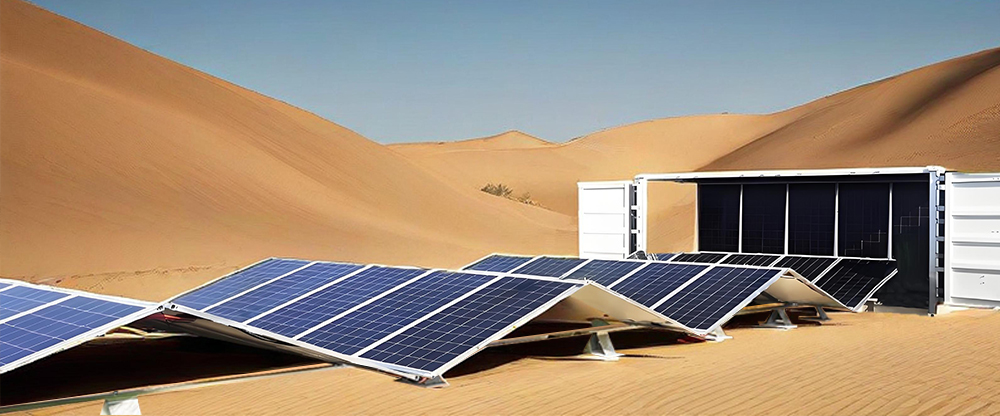
Long-term remote operations require a system that functions reliably over months or years without grid connection, in environments where fuel logistics are expensive or difficult. Mining camps, oil and gas exploration sites, remote telecommunications infrastructure, island communities, and agricultural stations in off-grid regions all fit this category. System reliability, smart monitoring for remote fault detection, and the option for hybrid diesel backup become priorities alongside initial deployment speed.
Temporary project-based deployments need power for the duration of a defined project — construction site phases, film productions, outdoor events, seasonal operations — and then need to be relocated. The asset-like nature of a containerized solar system, which can be transported and redeployed rather than decommissioned and written off, makes it economically attractive for these applications in ways that permanent solar cannot match.
Browse the full range of multi-scenario deployment solutions covering exploit, military, infrastructure, disaster relief, and port shore applications to see how integrated solar power addresses each category's specific requirements.
Integrated Systems: What's Inside and Why It Matters
The value of an integrated portable solar power solution is inseparable from how its components work together. A container that houses high-efficiency solar panels next to an undersized battery bank, or pairs a quality inverter with an inadequate charge controller, does not deliver reliable off-grid power — it delivers the individual components' specifications without the system performance those specifications promise.
Properly engineered integrated systems are designed as a matched set. The solar array size is matched to the battery bank capacity and the inverter's AC output rating. The charge controller's MPPT algorithm is tuned to the panel characteristics and the battery chemistry. The smart monitoring system tracks all components — panel output, state of charge, inverter load, battery temperature — and optimizes dispatch in real time, prioritizing load shedding to protect battery health during extended low-generation periods.
Optional hybrid capability — integrating a diesel generator as backup for extended cloudy periods or peak load events — extends operational reliability in environments where weather unpredictability would otherwise require significantly larger battery banks. The generator only runs when solar and storage cannot meet demand, minimizing fuel consumption and the operational cost penalties that make diesel power expensive over multi-month deployments.
For applications requiring greater storage capacity than a single solar container provides, dedicated battery ESS container solutions for energy storage can be paired with the solar container to extend autonomy without increasing the generating system's footprint — a common configuration for operations requiring overnight or multi-day storage reserves in regions with extended cloudy seasons.
The combination of speed, scalability, and system integration is what separates a plug-and-play modular solar container from both conventional solar installations and diesel generator alternatives. For operations where power follows the project — not the other way around — it represents a fundamentally different approach to off-grid energy supply, one that treats electricity as a deployable asset rather than a fixed piece of infrastructure.
